Your Complete Guide To Facial Peels
What they do, why they work, and how we choose the right one for your skin
If you hear the word peel and picture your face coming off in sheets, let me stop you right there.
Most of the peels I use in the treatment room are much more thoughtful than that. A good peel is not about removing as much skin as possible. It is about creating the right amount of controlled exfoliation for your skin so it can look brighter, smoother and more even without pushing it past what it can comfortably handle.
October is a the perfect time to talk about peels because many of us are coming out of summer with a little more sun exposure, uneven tone or congestion than we would like. But peel season is not an invitation to be aggressive. It is a chance to treat smarter.
So, what is a facial peel?
A facial peel uses a carefully selected exfoliating solution to loosen the bonds between older surface cells. As those cells release, fresher-looking skin is revealed and the renewal process underneath is encouraged.
That is the simple version. The more important version is that every peel has a depth, an intensity and a purpose. The formula I choose for you should be based on your skin not on what is trending, and definitely not on how dramatic the peeling looks afterward.
|
The amount you peel is not your scorecard. Your result is. |
Why peels are so effective
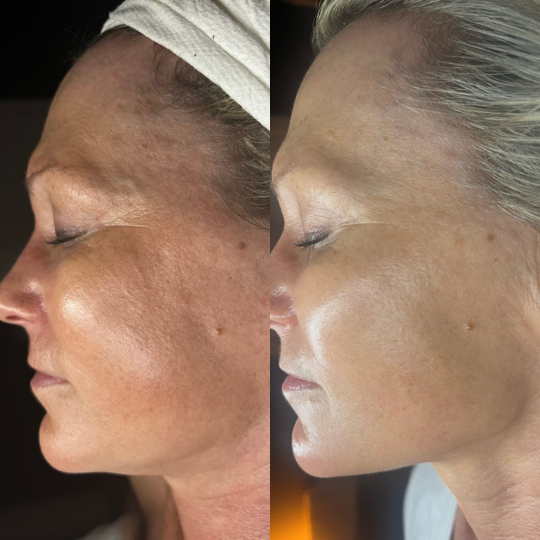
For brightness: When dull, compacted surface cells are lifted away, light reflects more evenly from the skin. That is why your complexion can look clearer and more luminous after a well-chosen peel.
For pigmentation: Peels can lighten pigment through the surface renewal cycle and improve the look of sun spots and post-breakout marks. Pigment is also where we need patience. Too much irritation can create more discoloration especially in deeper skin tones or skin that is prone to post-inflammatory pigmentation.
For a firmer, smoother look: Superficial peels mainly refine texture and create a smoother appearance. Medium and deeper peels may also stimulate remodeling in the skin, which can soften fine lines and make the surface look firmer over time.
Let’s talk about peel depth
Superficial peels
These work within the outermost layers of the skin. They are often the best place to begin and can be wonderful in a series. You may have no visible peeling at all, or a few days of light flaking. They are commonly chosen for dullness, mild uneven tone, congestion and rough texture.
Medium-depth peels
These travel beyond the surface into the upper portion of the dermis. They can create more meaningful change in sun damage, uneven pigmentation, fine lines and texture, but they also require more preparation, more downtime and very thoughtful aftercare. Redness, swelling and several days of peeling can be expected, with recovery often taking about a week or longer.
Deep peels
Deep peels reach farther into the dermis and can create dramatic resurfacing, but they come with significant downtime and risk. These are medical procedures not routine spa peels and belong in the hands of an appropriately qualified physician with careful monitoring.
“Strength” is more than a percentage
This is one of the biggest misunderstandings I hear. A 30% peel is not automatically stronger than every 20% peel. How a peel behaves depends on the acid, its pH, the formula it is carried in, how many layers are applied, how long it remains on the skin, how your skin was prepared and, most importantly, your individual skin barrier.
In other words, chasing the highest number is not the goal. Your skin does not need the strongest peel in the room. It needs the right peel.
Differences between the acids we use
Glycolic acid
An alpha hydroxy acid, or AHA, with a small molecular size. It can be very effective for brightness, texture and the look of fine lines, but its quick penetration means it needs to be chosen carefully for sensitive skin.
Lactic acid
Another AHA that is often a gentler, more hydrating choice. I love it for skin that needs glow and softness without an overly aggressive approach.
Mandelic acid
A larger-molecule AHA that penetrates more slowly. It can be a thoughtful option for uneven tone, blemish-prone skin and clients who need a more gradual approach.
Salicylic acid
A beta hydroxy acid, or BHA, that is oil-soluble. It is particularly useful when congestion, blackheads and breakouts are part of the conversation. It also needs special consideration for allergies and individual sensitivity.
TCA
Trichloroacetic acid can be formulated for different depths and is often used when we are addressing more established sun damage, pigmentation or texture. The concentration, technique and number of layers matter enormously, so this is not a treatment to experiment with at home.
Combination peels
These blend acids so we can address more than one concern or create a balanced result without relying on a single ingredient. The beauty of a professional treatment is that the formula and application can be matched to what your skin is showing us that day.
And what about enzymes?
Enzyme treatments are often grouped into the peel conversation, although they are not always technically acid peels. They help digest surface keratin and can offer gentle smoothing with minimal downtime perfect when your skin needs refinement but not a bigger resurfacing treatment.
Why I will always choose your skin over the trend
Before I recommend a peel, I want to know what you are using at home, whether you have recently waxed, how your skin handles inflammation, whether you are pregnant, taking certain medications, prone to cold sores or have had another procedure recently. Retinoids, an impaired barrier and even a little sunburn can completely change what is safe that day.
I am also paying close attention to your skin tone and pigmentation history. Deeper skin tones can absolutely benefit from peels, but the preparation, acid choice and aftercare must be respectful because inflammation can trigger unwanted darkening. Melasma also requires a long-game plan; an overly aggressive peel can make it rebound rather than resolve.
What to expect before and after
Before your appointment, follow the specific prep instructions we give you and be honest about every active product and recent treatment. Please do not arrive freshly waxed, sunburned or irritated.
Afterward, your job is simple: keep the skin calm, hydrated and protected. That means no picking, no scrubs, no extra acids or retinoids until you are cleared to restart them, and daily broad-spectrum SPF. If you flake, let it happen naturally. Pulling at peeling skin can create irritation, scarring and pigment.
And please, leave professional-strength peels to trained professionals. High-strength acids can cause serious burns and permanent injury when they are used without the right assessment and supervision.
Peels are one of my favorite tools because they are so adaptable. They can be gentle and progressive or more corrective when your skin is ready. The magic is not in making you peel the most. It is in choosing the right chemistry, at the right depth, at the right time and pairing it with the home care that protects your result.
So if you have been wondering whether a peel could help with dullness, sun spots, post-breakout marks or texture, let’s talk. We will look at your skin together and choose a plan that makes sense for you. No pressure. No guessing. Just smart, personalized skin care.
xoxo,
Melissa